بسم الله
In this article, we are going to solve the second challenge of Flare-On (2015). As usual, we rely on the Learning-by-Doing methodology and the Just-in-Time Learning approach.
1. Downloading and Extracting the Challenge
We download the challenge from the official website: flare-on.com
Archive password: flare.
After extraction, we get a file without an extension, so we inspect it in HxD to determine its real type:
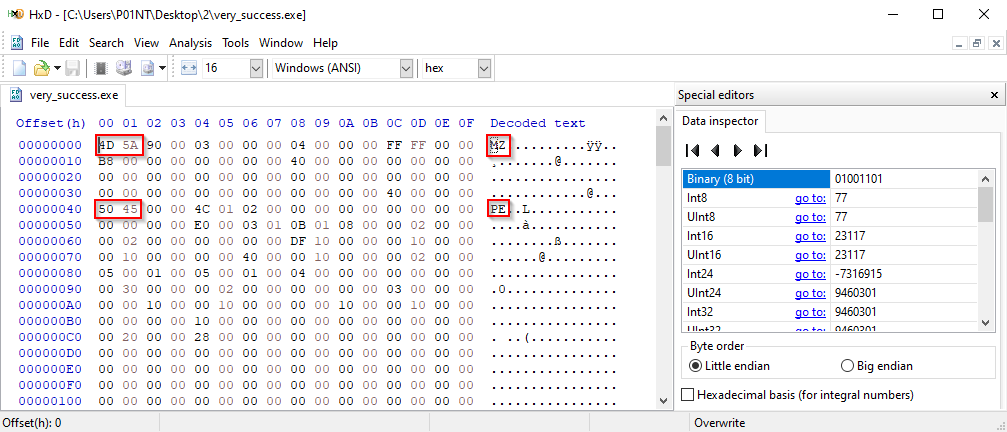 Figure (1): Inspecting the file in HxD
2. Identifying the File Type and Renaming It
As shown in the image, the file is a PE (Portable Executable), so we rename it to .exe.
3. First Run and Observing the Behavior
After renaming, we run the program from a CMD window:
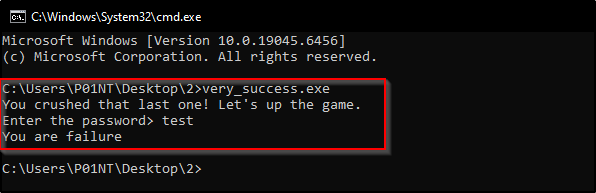 Figure (2): Running the program
The program shows:
You crushed that last one! Let's up the game.
Enter the password>
Meaning: “You beat the previous challenge! Let’s up the game,” then it asks for the password. After typing anything, it gives us the result.
Let’s dive into the program and statically analyze it in IDA Pro.
4. Static Analysis: A Weird Prologue
At the start of the code, we notice a deliberate mistake in the prologue of sub_401000:
sub_401000 proc near
.text:00401000 pop     eax
.text:00401001 push    ebp
.text:00401002 mov     ebp, esp
Normally, a function begins with push ebp to build its own stack frame, but here a pop eax instruction was added before it. This instruction pops the return address off the top of the stack — or whatever operand was pushed before the call — into eax. We will see its importance shortly.
Looking at the code, we see that two handles are defined: one for writing and one for reading:
- Write handle
[ebp-8]: (stdout, message,0x43). - Read handle
[ebp-0Ch]: (stdin,unk_402159,0x32).
.text:00401004                 sub     esp, 10h
.text:00401007                 mov     [ebp-10h], eax
.text:0040100A                 push    0FFFFFFF6h        ; STD_INPUT_HANDLE
.text:0040100C                 call    GetStdHandle
.text:00401012                 mov     [ebp-0Ch], eax
.text:00401015                 push    0FFFFFFF5h        ; STD_OUTPUT_HANDLE
.text:00401017                 call    GetStdHandle
.text:0040101D                 mov     [ebp-8], eax
.text:00401020                 push    0
.text:00401022                 lea     eax, [ebp-4]
.text:00401025                 push    eax
.text:00401026                 push    43h               ; 'C'
.text:00401028                 push    offset aYouCrushedThat ; "You crushed that last one! Let's up the game."
.text:0040102D                 push    dword ptr [ebp-8]
.text:00401030                 call    WriteFile
.text:00401036                 push    0
.text:00401038                 lea     eax, [ebp-4]
.text:0040103B                 push    eax
.text:0040103C                 push    32h               ; '2'
.text:0040103E                 push    offset unk_402159
.text:00401043                 push    dword ptr [ebp-0Ch]
.text:00401046                 call    ReadFile
5. Calling the Verification Function
Going further down, we see six operands pushed onto the stack, but we only need to focus on three:
.text:0040104C                 push    0               ; lpOverlapped
.text:0040104E                 lea     eax, [ebp-4]
.text:00401051                 push    eax             ; lpNumberOfBytesWritten
.text:00401052                 push    11h             ; nNumberOfBytesToWrite
.text:00401054                 push    dword ptr [ebp-4]      ; number of bytes read
.text:00401057                 push    offset unk_402159      ; user input
.text:0040105C                 push    dword ptr [ebp-10h]    ; secret operand (the pop eax value)
.text:0040105F                 call    sub_401084
.text:00401064                 add     esp, 0Ch
The three important operands:
[ebp-10h]: the value that was first popped bypop eax— could be an XOR key, the expected value, or a return address.unk_402159: the user input.[ebp-4]: the actual length of the input the user typed.
The other three operands stay on the stack and do not affect execution — they are just distraction.
After that, sub_401084 verifies the flag, because right after the call there is a test followed by a conditional jump, and the condition is eax != 0.
6. Analyzing the Verification Function sub_401084
Let’s dig deeper into the function:
sub_401084 proc near
    push    ebp
    mov     ebp, esp
    sub     esp, 0          ; no extra space (just a frame)
    push    edi
    push    esi
    xor     ebx, ebx        ; ebx = 0 (rolling sum bx)
    mov     ecx, 25h        ; ecx = 37 (required byte count)
    cmp     [ebp+arg_8], ecx ; if input length < 37 -> fail
    jl      loc_4010D7
    mov     esi, [ebp+arg_4]  ; esi = pointer to the input buffer
    mov     edi, [ebp+arg_0]  ; edi = pointer to the hidden buffer
    lea     edi, [edi+ecx-1]  ; edi = edi + 36 (points to the last hidden byte)
Clearly, the function takes 3 arguments using the cdecl calling convention. Going back to the calling code, we identify them:
arg_0 (ebp+8)=[ebp-10h]→ the hidden data.arg_4 (ebp+0Ch)=unk_402159→ the user input.arg_8 (ebp+10h)=[ebp-4]→ the input length.
Key points to focus on:
ebx = 0: the rolling sum.ecx = 37: a counter, most likely the correct flag length.esi: points to the start of the user input.edi: points to the end of the hidden arrayhidden[36].
7. The Main Loop loc_4010A2
loc_4010A2:
    mov     dx, bx        ; dx = low part of rolling sum (bx)
    and     dx, 3         ; dx = bx & 3 (take only the last two bits)
    mov     ax, 1C7h      ; ax = 0x1C7
    push    eax           ; save eax on the stack
    sahf                  ; load ah (0x01) into EFLAGS flags -> set CF = 1
    lodsb                 ; al = a byte of user input (from esi), then esi++
    pushf                 ; save the current flags on the stack
    xor     al, [esp+4]   ; al = al XOR 0xC7
    xchg    cl, dl        ; swap cl and dl (cl = counter, dl = bx&3)
    rol     ah, cl        ; rotate ah (0x01) by (bx&3) -> ah = 1 << (bx&3)
    popf                  ; restore the flags (CF = 1)
    adc     al, ah        ; al = al + ah + CF
    xchg    cl, dl        ; restore cl and dl
    xor     edx, edx      ; edx = 0
    and     eax, 0FFh     ; eax = al only
    add     bx, ax        ; bx = bx + al (rolling sum)
    scasb                 ; compare al with [edi] then edi++ (DF=0)
    cmovnz  cx, dx        ; if not equal (ZF=0): cx = dx = 0 -> early fail
    pop     eax           ; restore 0x1C7 from the stack
    jecxz   loc_4010D7    ; if cx == 0 -> exit with failure
    sub     edi, 2        ; edi = edi - 2 (net edi-- after the scasb increment)
    loop    loc_4010A2    ; decrement ecx and jump while ecx != 0
    jmp     short loc_4010D9 ; success
Let’s break these instructions down carefully:
7.1 The Secret Behind xor al, [esp+4]
push    eax          ; stores 0x1C7 on the stack
sahf                ; transfers ah (0x01) into the low byte of EFLAGS
lodsb               ; reads a byte of input into al
pushf               ; pushes the current flags onto the stack
Now the stack contains: [esp] = flags, [esp+4] = the value 0x1C7 (in little-endian: C7 01 00 00). So [esp+4] = 0xC7:
xor al, 0xC7
7.2 The Rotation Power R
xchg    cl, dl      ; cl = counter, dl = bx&3  -> after the swap: cl = bx&3
rol     ah, cl      ; ah = 1 << (bx&3)
Before these instructions:
clholds the counterecx(starts at 37 and decreases).dlholdsbx & 3.
After xchg cl, dl, cl becomes bx & 3, then rol ah, cl rotates ah (value 0x01) by bx & 3:
bx & 3 | ah after rotate |
|---|---|
| 0 | 0x01 |
| 1 | 0x02 |
| 2 | 0x04 |
| 3 | 0x08 |
So ah becomes a power of two. Let’s call it R.
7.3 The Full Operation
After popf we restore the flags saved before xchg and rol, and the carry flag CF = 1 (from sahf where ah = 0x01). This turns adc al, ah into:
al = al + R + 1
Since al was XORed with 0xC7, the full operation on the input byte is:
T = ((input_byte XOR 0xC7) + R + 1) mod 256
Where T is the expected (hidden) byte that the result must be compared against.
Important: The value of
Rdepends onbx, andbxis the rolling sum of previousalvalues (i.e.,Tfor every byte successfully compared). This is the key point: to compute the requiredinput_byte, we need to knowbxbefore processing that byte.
8. Reversing the Loop
The loop processes the bytes of the hidden array from last to first (due to lea edi, [edi+ecx-1] then sub edi, 2 with scasb each iteration), while reading the input in forward order. So:
hidden[36]  is compared with  input[0]
hidden[35]  is compared with  input[1]
...
hidden[0]   is compared with  input[36]
To reverse the process and get the input in the correct order, we walk from hidden[36] down to hidden[0]. The reverse equation:
(input_byte XOR 0xC7) = (T - R - 1) mod 256
input_byte = ((T - R - 1) mod 256) XOR 0xC7
Steps for each byte starting from hidden[36] down to hidden[0]:
- Compute
R = 1 << (bx & 3). - Compute
input_byte = ((T - R - 1) & 0xFF) XOR 0xC7. - Store the result (it will be reversed for now).
- Update
bx = (bx + T) & 0xFFFF.
Worked Example Step by Step
The hidden data (37 bytes) as we extracted it:
hidden = [
  0xAF, 0xAA, 0xAD, 0xEB, 0xAE, 0xAA, 0xEC, 0xA4, 0xBA, 0xAF, 0xAE, 0xAA,
  0x8A, 0xC0, 0xA7, 0xB0, 0xBC, 0x9A, 0xBA, 0xA5, 0xA5, 0xBA, 0xAF, 0xB8,
  0x9D, 0xB8, 0xF9, 0xAE, 0x9D, 0xAB, 0xB4, 0xBC, 0xB6, 0xB3, 0x90, 0x9A, 0xA8
]
Step 1 (i = 36): T = 0xA8, bx = 0x0000
bx & 3 = 0→R = 1input_byte = ((0xA8 - 1 - 1) & 0xFF) XOR 0xC7 = 0xA6 XOR 0xC7 = 0x61→'a'bx = 0x0000 + 0xA8 = 0x00A8
Step 2 (i = 35): T = 0x9A, bx = 0x00A8
0xA8 & 3 = 0→R = 1input_byte = ((0x9A - 1 - 1) & 0xFF) XOR 0xC7 = 0x98 XOR 0xC7 = 0x5F→'_'bx = 0x00A8 + 0x9A = 0x0142
Step 3 (i = 34): T = 0x90, bx = 0x0142
0x0142 & 3 = 2→R = 4input_byte = ((0x90 - 4 - 1) & 0xFF) XOR 0xC7 = 0x8B XOR 0xC7 = 0x4C→'L'bx = 0x0142 + 0x90 = 0x01D2
And so on until all bytes are processed.
9. Where Does the Hidden Data Come From?
Moving to the start function, we see a set of confusing instructions. Most likely these opcodes were deliberately placed, and going a bit further we see a block of data defined in the .text section. Let’s count 37 bytes from it — that is the hidden array pulled in before sub_401000 begins:
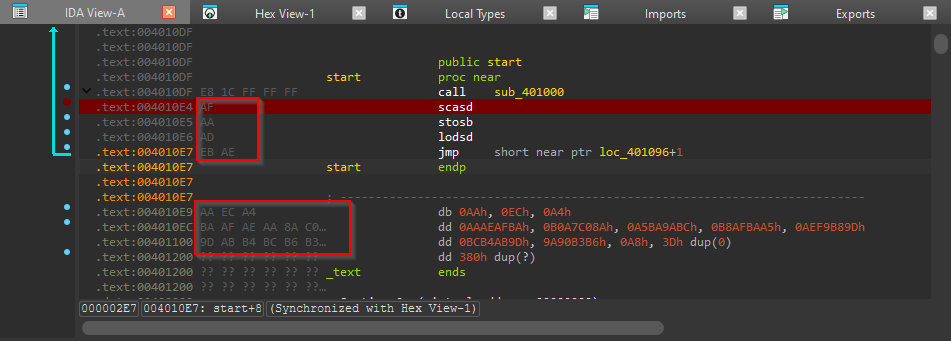 Figure (4): The hidden data inside the .text section
10. Writing an IDC Script to Recover the Flag
Now we can write an IDC script (available even in the free version of IDA) to find the flag:
#include <idc.idc>

static main()
{
    auto arg0, i, bx, ref_addr, ref_byte, shift, rot, candidate, out, flag;
    arg0 = 0x4010E4;    // address of the hidden data
    bx = 0;
    flag = "";          // accumulate the result as text

    for (i = 0; i < 37; i++)
    {
        // reference address = arg0 + 36 - i (reverse linear walk)
        ref_addr = arg0 + 36 - i;
        ref_byte = Byte(ref_addr);
        shift = bx & 3;
        rot = 1 << shift;   // 1, 2, 4, 8

        for (candidate = 0; candidate < 256; candidate++)
        {
            out = ((candidate ^ 0xC7) + rot + 1) & 0xFF;   // note the XOR with 0xC7
            if (out == ref_byte)
            {
                flag = flag + sprintf("%c", candidate);   // append the character directly
                bx = (bx + out) & 0xFFFF;
                break;
            }
        }
    }

    Message("Flag: %s\n", flag);
}
How to Run the Code Inside IDA?
Go to File → Script file… and select the .idc file containing the code above.
11. Result and Final Verification
When the script runs, the following flag appears:
 Figure (5): The flag produced by the script
We copy it and try it:
a_Little_b1t_harder_plez@flare-on.com
 Figure (6): Verifying the correct flag
And with this, we have successfully solved the second challenge. To be continued, God willing.