بسم الله
Having taken an overview of the computer’s structure in the first article, and dived into what happens inside the processor in the second one, today we meet the theoretical foundation linking binary instructions to the operations the processor executes. This article also serves as a practical introduction to Assembly, explaining the structure of its code. Here are the topics we will cover:
Instruction Set Architecture (ISA)
The Instruction Set Architecture (ISA) is the theoretical foundation connecting machine code to the instructions the CPU executes:
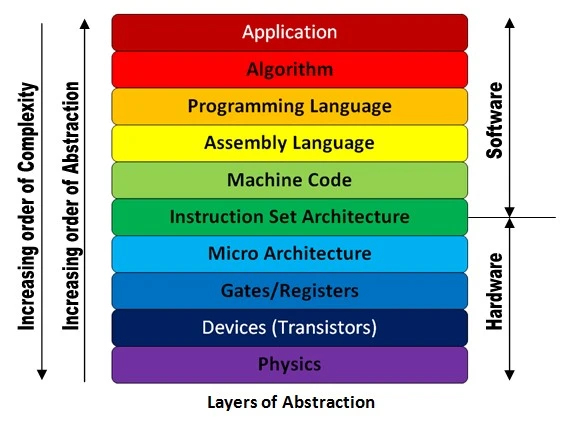 Figure (1): Where the ISA sits between software and hardware
The ISA defines: the instructions supported by the processor, data types, registers, how memory is accessed, addressing modes, and other fundamental details.
In other words, the ISA is the language of communication between software and hardware — without descending into the fine details of the internal design (the microarchitecture).
Machine Instruction Characteristics
A machine instruction consists of two parts:
• Opcode:
Determines the kind of action to perform — the command itself (mov, add, etc.).
• Operands: Refer to the target data the action applies to. Each instruction is stored in memory as a sequence of bytes.
Essential Facts
Instruction format and length: As mentioned, every instruction consists of an opcode and operands; on x86, instruction lengths vary from 1 to 15 bytes.
Operand count: x86 instructions allow zero to three operands, and most opcodes take two: a source and a destination. In Intel syntax the destination comes first, then the source. For example:
mov eax, ebx
has two operands: the register eax — the destination that will receive the value — and the register ebx — the source the value is read from.
Byte ordering (Endianness):
x86 uses Little Endian ordering: the least significant byte is stored first in memory. The value 0x12345678 is laid out in memory as 78 56 34 12.
Example:
mov  eax, [a]     ; move the value of variable a into EAX
add  eax, [b]     ; EAX now holds a, so add the value of variable b
mov  [sum], eax   ; move the resulting value from EAX into sum
Types of Operands
An operand in machine code is whatever refers to the data being processed, and it can be one of the following:
1. Immediate: A numeric constant embedded directly in the instruction itself:
mov ebx, 5 ; move the constant 5 into EBX
2. Register: The operand may be a processor register:
mov eax, ebx ; move the contents of EBX into EAX
3. Memory address: The operand may be a memory address:
mov eax, [ebx] ; move the value stored at the address held in EBX into EAX
Combined example:
mov  eax, [a]     ; here a (memory) and eax (register)
add  eax, [b]     ; b (memory)
mov  [sum], eax   ; sum (memory)
x86 Data Types
The x86 processor supports several data types, the most important being:
- Byte: the fundamental unit of data, 8 bits.
- Word: 16 bits.
- DoubleWord: 32 bits.
- QuadWord: 64 bits.
Example: suppose we have this C code:
char c = 'A';
short s = 1000;
int i = 100000;
Here is how their sizes map onto assembly registers:
mov  al, 'A'       ; AL is an 8-bit subdivision of AX
mov  ax, 1000      ; AX is the 16-bit half of EAX
mov  eax, 100000   ; the full 32-bit EAX
Types of Operations
Broadly speaking, there are fundamental operations from which virtually any code is composed — you could say about 90% of any program consists of these opcodes:
• Arithmetic & Logic:
Includes add, sub, mul, and div, plus the logic operations not, and, or, and xor. These instructions modify values in registers or memory.
• Data Transfer:
Instructions that move data between registers, memory, or input/output. The most famous is mov, which carries a value from a source (register, memory, or immediate) to a destination (register or memory). We also have push and pop for manipulating the stack.
• Control Flow:
Instructions controlling program execution: unconditional jumps (jmp), conditional jumps based on comparisons such as cmp paired with je/jne/jle and friends, plus function-call instructions call and ret. These rely on comparing values and changing the Instruction Pointer.
• Input/Output (I/O):
x86 has dedicated instructions for dealing with input and output devices, such as in and out, allowing reads and writes to device ports.
Example: suppose we have this C code:
int a = 10, b = 3, c;                 // declare variables a, b, c
if (a > b) c = a - b; else c = 0;     // if a > b then c = a - b, else c = 0
This is its representation in assembly:
mov  eax, [a]
cmp  eax, [b]      ; compare a with b
jle  L_else        ; if a <= b, jump to the else branch
sub  eax, [b]      ; otherwise execute: a = a - b
mov  [c], eax
jmp  L_end         ; skip the else branch once done
L_else:
mov  dword [c], 0  ; else case: c = 0
L_end:
Notice how the if condition becomes a cmp instruction that sets the flags, followed by a conditional jump jle that inspects them: if the condition fails (a <= b), execution jumps to the else branch; if it holds, the subtraction runs and an unconditional jmp hops over the else branch.
Summary
By understanding the Instruction Set Architecture — knowing that a machine instruction consists of an opcode and operands, and the types of each — you become able to translate binary code into assembly and follow how a program moves step by step.
Keep us in your prayers.